Thursday, November 12, 2020

INTERVIEW: NO GODS, NO MASTERS — CINNAMON ANARCHY CELEBRATES 20 YEARS OF ‘HOLY WOOD’


“Marilyn Manson gave me the security in knowing I was not alone.”
— CINNAMON ANARCHY

This article was previously published on November 11, 2020 as an exclusive for CULT members.

Today marks the 20th anniversary of Marilyn Manson’s Holy Wood — an album that needs no introduction.

We wanted to do something special for our CULT members to celebrate the occasion. Any site can do a retrospective album review, but where’s the fun in that? Sometimes, you have to spice things up.

Enter Cinnamon Anarchy, a gothic alt model and adult entertainer who’s been making black hearts flutter for years. As it turns out, she’s a big fan of dark musicians, particularly the Antichrist Superstar himself: Marilyn Manson.

Without further ado, let’s take a peek into the mind of Manson acolyte Cinnamon Anarchy:


DARKNESS CALLING: When did you first discover darker music and know that it was a good fit for you? What was that experience like, and what are some of those earliest musical memories?

CINNAMON ANARCHY: Dark music touched me in a deep way when I was thirteen. I remember having a particularly crappy day at school where a boy giggled at my chest and said, “You have big boobies.” At this point, I had no clue what he was talking about, but I realized really quick that there is just no easy way to be a very busty, awkward, young teenage girl.

On the bus ride home, a senior girl that sat next to me could tell I had a rough day, and she let me share her headphones. I listened to Nine Inch Nails and Marilyn Manson the whole ride home. Something clicked as the lyrics, “Now doesn’t it make you feel better?” [“March of the Pigs” by Nine Inch Nails] gave me that realization.

She took me to my first Manson concert (the Antichrist Superstar tour). She also helped me realize that my body was all I needed to get anything I wanted and more. She ended up becoming my first kiss, my first sexual encounter. She started me on a path of musical and sexual liberation. With her, I had my first musical awakening.


DARKNESS CALLING: Was that bus ride home your first encounter with Marilyn Manson?

CINNAMON ANARCHY: Actually, I was nine when I first saw Marilyn Manson on MTV — back when they actually played real music. It was the “Lunchbox” video. Seeing that kid get bullied and pushed around really touched a soft spot. Marilyn Manson gave me the security in knowing I was not alone. It was solace to me when I had a rough day.

It is my belief that everyone could stand to listen to some Marilyn Manson. After all, we all feel oppressed by someone, at some point in our lives. Manson’s music is made for the martyrs that get tyrannized by society. From the moment I heard Marilyn Manson, I was addicted. Like Manson, I always wanted to be the kind of super-heroine that thwarted the antagonists abusing those who live outside of societal norms.


DARKNESS CALLING: Today marks the twentieth anniversary of Holy Wood. What are some of your favorite tracks on that album, and why?

CINNAMON ANARCHY: That album is GREAT. It has a heavy, glam rock façade. Manson is just all-encompassing with this album. I honestly think it was one of the best releases in all of 2000. Unfortunately, it got cloistered by Eminem’s controversial content [Eminem’s “Stan” was released that same year] and this album is, in its entirety, wholly underappreciated and uncredited! This album didn’t get the press it should have.

“Cruci-fiction In Space” has such an industrial assimilation; Manson lends the Antichrist Superstar feel with his guttural voice parallel to his earlier albums. The guitar is carnal. The bass is methodical — almost militant. I enjoyed the likeness to David Bowie. Manson has a knack for provoking goosebumps!

“Target audience (Narcissus Narcosis)” is one of the most underrated tracks of the album.

“Lamb of God” is such a vampish song, with the acoustic guitar just a few power chords off from being “Hurt” by Nine Inch Nails.

“The Nobodies” is one of my favorite songs to listen to while getting ready for a shoot or doing makeup, because it is just so sensual and seductive.


DARKNESS CALLING: I imagine there’s some correlation between your affinity for darker vibes in music and the darkness you bring to your image / your presence in the adult entertainment scene. Are there any thoughts you could share about this?

CINNAMON ANARCHY: Marilyn Manson has always been my inspiration in my fetish work, from the costumes he wore throughout the years (goth, military, glamour, feathers) long pin straight hair, black leather, corsets, dark thick eyeliner, contacts. I always wanted to emulate his look, his cult mentality.

He is a walking, breathing sex symbol that oozes eroticism. From pissing on thousands in the audience, to coming out on stage with a strap-on. Everything “Manson” is just so provocative, androgynous, and charismatic! I have always tried to indulge my audience, contravening rules, diving headfirst into what some would perceive as utterly repugnant, indulging my fans’ taboos — all because of Manson’s archetype.


DARKNESS CALLING: When did you decide to become “Cinnamon Anarchy” and how liberating was the transformation?

CINNAMON ANARCHY: My turning point came when I ended a nine-year marriage. I was subjugated. I had married the most normal vanilla (without kink) person alive. I felt trapped in a “stepford wife” deathloop. I was so sexually and mentally disheartened. I found Fetlife.com and it made me realize that I wasn’t the only sexually repressed person out there. In fact, it is a VERY deep, strong, close-knit community. They — along with the music — helped shape me into who I am today.

The thought process behind “Cinnamon” is the strongest aphrodisiac known to mankind, second only to vanilla (which I definitely am not). “Anarchy” represents my disdain for the ordinary, contumacious outlook on authority. No gods, no masters. Cinnamon Anarchy was the chaotic, whimsical guise I desperately needed. She was the catalyst at this vulnerable time in my life. As the transformation took place, I saw tiny fragments of all my favorite rockstars bleeding through. I had finally felt it was okay to show “the real me” that I had been hiding for so many years.


DARKNESS CALLING: In “real life,” do you listen to any particular music when you have sex? What kinds of things would be on your “fuck playlist”?

CINNAMON ANARCHY: This is a tough one. I suppose it would depend on the partner and the mood. My slow, intimate sex playlist includes albums like Type-O-Negative’s October Rust and Nine Inch Nails’ Ghost V and Ghost VI. A primal, deep, hot-and-heavy fuck session soundtrack would encompass Manson’s Smells Like Children, Holy Wood — anything Manson. NIN’s Downward Spiral or Pretty Hate Machine…

There are way more than this, though. I love letting the other person pick the music. Occasionally, it adds to the excitement. For my clients looking to be entirely obliterated during a Femdom session, Danny Elfman’s music usually does the trick.


DARKNESS CALLING: Thank you so much for sharing this side of yourself with us. What’s the best way for newcomers to learn more (and see more) of Cinnamon Anarchy?

CINNAMON ANARCHY: My comprehensive media list is here. I do have quite a few of my “consensual lifestyle slaves” tending the majority of my media outlets, as I film custom taboo content daily. I can’t always guarantee everywhere you try to reach out to me will be “the” Cinnamon Anarchy, but I try my best to be cordial and friendly to each and every fan I encounter. After all, I am nothing without my friends and fans out there. That being said, I do have an insane cult following, but I do always drop in on my 0nlyFans, Fetlife, and P0rnhub followers. They are my babies! I always tend to those outlets first.

INTERVIEW: AUDIO ENGINEER KENNAN KEATING LOOKS BACK ON 31 YEARS OF ‘PRETTY HATE MACHINE’


“All of a sudden, it was a huge thing. There was nothing, and then all of a sudden, it was like everybody’s walking around with NIN shirts. After I mixed the record — it was maybe six months later — I was like, ‘What is the N.I.N.? What is that?’ And my wife is like, ‘Oh, that’s Nine Inch Nails.’ I said, ‘Nine Inch Nails?! I did that!’”
— KENNAN KEATING

This article was previously published on October 20, 2020 as an exclusive for CULT members.

October 20th marks the 31 year anniversary of Pretty Hate Machine, an album that needs no introduction. [But we’re going to write one anyway.]

What can DarknessCalling.net say about PHM that hasn’t already been said? It’s undeniably one of the most significant albums of all time, despite the towering presence of its younger brother The Downward Spiral. While TDS may be Nine Inch Nails’ most celebrated work, we would argue that Pretty Hate Machine presents a more vulnerable, honest portrait of Trent Reznor who — in 1989 — was roughly 24 years old and still finding his place in the world:

“Really, Pretty Hate Machine was born from tinkering around in the studio at night,” he once told Rolling Stone. “I stayed up late at night, trying to figure out who I was, what I had to say as a songwriter. And things started to pop out.”

Audiophiles and NIN fanatics know the name Flood, but less-discussed is Keith LeBlanc, the producer who added a significant amount of magic to Reznor’s debut, particularly when it came to “Head Like A Hole.”

Trent Reznor, November 2019: “I went back in and re-tweaked ‘Head Like a Hole.’ Keith LeBlanc did a mix that felt right, one that turned up the aggression a little bit more, and that’s the version that is out.”

LeBlanc was involved in production, mixing, and sound engineering on five of Pretty Hate Machine’s ten tracks, and LeBlanc’s right-hand-man was none other than Kennan Keating, an accomplished audio engineer in his own right. Keating has worked with everyone from ZZ-Top to LaToya Jackson, and he contributed some small but impactful tweaks to Pretty Hate Machine that have been cemented in our memories for 31 years.

DarknessCalling.net was lucky enough to chat with Keating about his work, his memories of those PHM sessions, and what the future holds. Read on below.


DARKNESS CALLING: Thank you for giving us the opportunity to speak with you about your work. Outside of NIN, I know that you have a diverse range of credits, and you did a lot of work for TVT Records, in particular. At the time, I assume Pretty Hate Machine was just another TVT job for you?

KEATING: Well, I did a lot of work for Keith LeBlanc, who was the drummer for The Sugarhill Gang. We were doing mainly dance, R&B, and hip-hop at Unique [Recording Studios], and that was the draw there. Trent was into that, so that’s why he came in to work with Keith, who is a master at hip-hop rhythms.

Keith LeBlanc had also been working with Chris Lord-Alge, who I assisted for about a year while I moved up to engineer. Chris just got super busy. Everyone wanted him, and Keith knew I could get the “Lord-Alge sound,” so it was on.

I was on several projects with Keith, and then one day, he said, “Hey, I’ve got this other project. It’s not a lot of money, but would you mind doing me a favor and just do it?” I said, “Sure, I’ll do it.” I had no idea what it was.

Then Trent shows up. Kind of a mild-mannered guy. You would have never thought that this kid was going to be Satan’s lovechild for the public. [Laughs.] He was kind of a normal guy. Very smart. Educated, obviously. Well-spoken. A very smart kid.


“...my jaw hit the floor. I just said, ‘Oh, man. This guy’s for real.’”
— KENNAN KEATING ON TRENT REZNOR

KEATING: Honestly, Trent had his shit so much more together than most people that come into the studio. I mean, this man was a one-man business, and you could tell from the get-go. It was when he told me that he played all the guitar that my jaw hit the floor. I just said, “Oh, man. This guy’s for real.”

Keith was there to add a few touches to it [Pretty Hate Machine], but Trent had basically everything already on his computer when he came to the studio. We were just doing sweetening and mixing for the album.

Trent was very sure of himself. I remember that. He knew what he wanted — exactly — for the most part. I was able to do a few creative things, but a lot of the stuff that I was trying to do, he was like, “No, I don’t want that.” [Laughs.]

But he was very easy to work with. He might rein me in on some of my more excessive mix choices, but he always listened first and commented later. Also, I was tickled to work on the same album with Flood, who I really love as an engineer and producer. Trent clearly knew how to pick them.

All in all, I’m pretty proud of the soundstage that I set up for Trent’s songs, along with the effects and various treatments that I used. And he was generally pretty happy with everything. But when he wasn’t, he let me know real quick!

DARKNESS CALLING: Do you remember any of your little ideas that maybe did stick, or that made it onto the album?

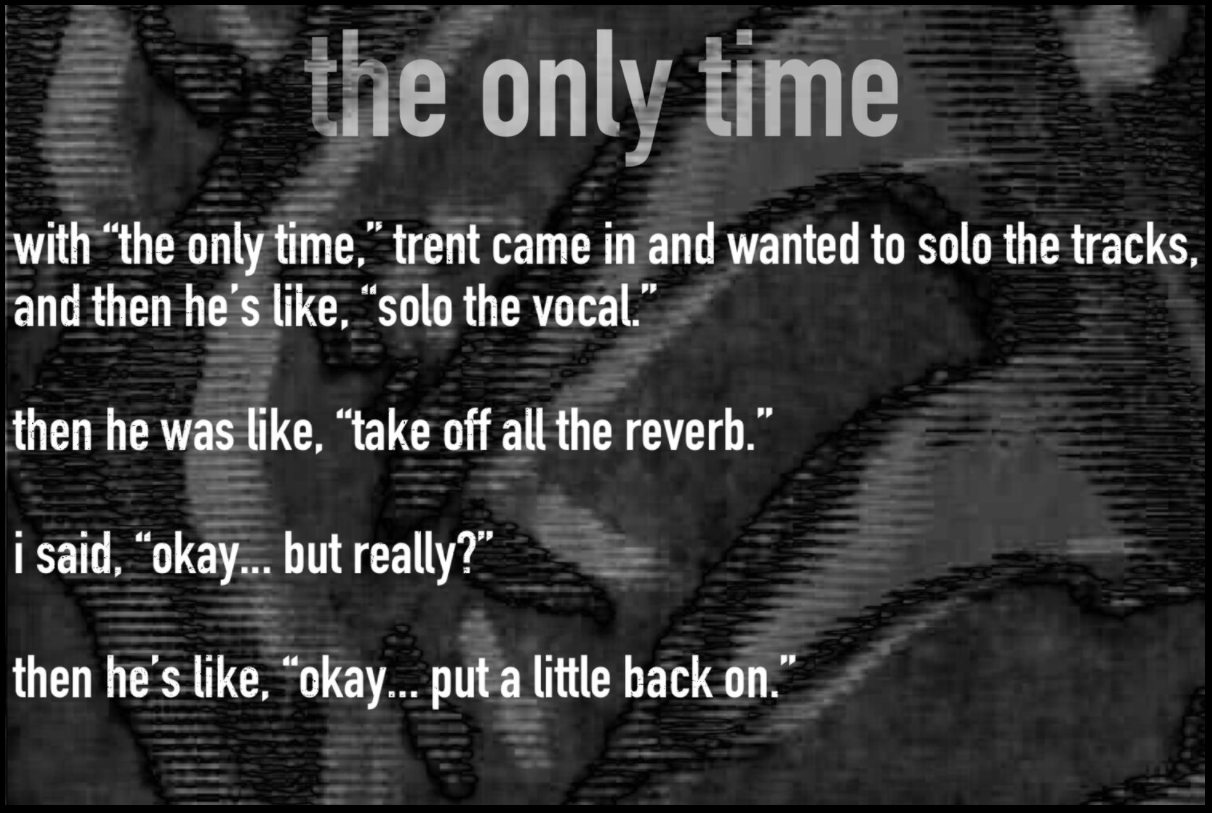
KEATING: It’s not so much the ideas, but the treatment of sounds. I’d put a little reverb on this or put some delay on that. I’m usually pretty creative with my mixes, and I put a lot of myself into them. I had a few things that he let me get away with, but otherwise, he was kind of like, “I want it like this, and that’s how I want it.” And that was fine with me. I actually like that — when people know exactly what they want. Then you know you’re not going to be coming back to re-do something.


DARKNESS CALLING: I know that Trent has sometimes been described as a dictator, but it’s still very exciting to speak with someone who was involved in shaping some of those sounds and delivering the final recorded product to us. Do you have any fly-on-the-wall moments — memories you could talk about that wouldn’t get you or me in trouble?

KEATING: [Laughs]. No, it really wasn’t anything like that. It was definitely not a social thing. A lot of sessions are — artists will bring their posse with them, and you’ll hang out and party and whatnot. But it was nothing like that. He would show up and we would work all day, basically. A dictator’s not far from the truth. [Laughs.] But like I said, he had done all the work beforehand, and I recognized his genius immediately. We had a great rapport. He would tease me, and I’d tease him, back-and-forth. It was a brutal work schedule, as I said, but fun was had.


DARKNESS CALLING: I know that TVT wasn’t used to managing anything quite like NIN at the time, and of course Trent fought for a long time after that to get away from TVT. What would you say about your experiences working with the label?

KEATING: I’ll tell you one thing I didn’t really like was the fact that I didn’t get the proper credit on the mixes. I mixed five of the songs on the record [“Head Like A Hole,” “Down In It,” “Kinda I Want To,” “Sin,” and “The Only Time”], and they roped me in with everybody, whereas I felt that I should have been listed on the songs as “mixed by.” But that was because TVT Records was kind of a little lax about stuff. The independent labels in those days — you had to chase them around to get anything done.

DARKNESS CALLING: As it currently stands, I think your formal credits list you as an audio engineer for those five songs. What’s neat about that is that three of those tracks are some of NIN’s biggest singles, so even as an audio engineer, it’s still an incredible accomplishment in its own right. With that said, it’s a shame if you weren’t properly credited.

KEATING: Yeah, I would have really preferred to be listed as “mix engineer,” because that was my speciality that I was bringing to the table. Although I did do it as a favor in a way, it’s funny how these things blow up. It’s always the thing that you least expect that — all of a sudden — “Wow, this blew up.”


DARKNESS CALLING: I know you were mixing a lot of things back then for Unique Recording Studios (1984-1996).

KEATING: Yeah, that was a very creative environment over there. We had all the latest tech gear there. Every time something new would come out — and a lot of new stuff was coming out — the guy that owned the studio, Bobby Nathan, was always the first to get this stuff. As soon as he heard about it, he would get on the phone and get one in the studio to try it out.

Pretty Hate Machine was mixed in Studio C, which had just gotten an upgrade from the Neve console to a SSL board with the ABC buss network, so I could separately process the track, vocals, and FX on the 3 busses feeding the master. It very much came in handy!

Unique Recording Studios was kind of a destination. A lot of artists were trying to be cutting edge, and plus we were the cheapest studio in town, too, which the other studios weren’t very happy about. [Laughs.] But we got a lot of business that way. Plus, as engineers, we all learned the MIDI stuff before anybody else knew how to do it, so we were MIDI’ing, putting samples out… All the hip-hop guys were coming in to us because it was cutting-edge technology. Now everybody has it, but back then, it was kind of special.


DARKNESS CALLING: What else can you tell us about the recording process on PHM, in terms of the technology back then?

KEATING: I’m pretty sure that Trent brought in his own computer. He had it all on a computer. I think he dragged his actual desktop into the studio, and we were there for the better part of a week. He downloaded a lot of stuff, and we recorded a few tracks, but mostly the vocals and everything were all downloaded off his computer.

At the time, there weren’t a lot of people doing that. We were working with two-inch tape. So what we did was transfer all his files to tape. That was a big process.

DARKNESS CALLING: So, it’s kind of like he was trying to go all-digital already, and you had to kind of reverse the process a little bit to make it fit into your typical workflow for how things would get done in the studio?

KEATING: Exactly. 


DARKNESS CALLING: Speaking of which, I wanted to ask you about your feelings regarding the older, analog recording technology compared to now, where pretty much everything is digital.

KEATING: It’s much easier to do it now. But I liked the fact that there were a lot of happy accidents with tape. There were things that would happen that don’t happen now in the digital world. But I try to create happy accidents when I’m working in the computer now, too. Sometimes, you just set up something randomly, like bringing something up on a channel that’s not intended to be brought up, just to see how it sounds. I like working with a lot of effects and stuff. It’s always fun playing around, trying to get the vibe on things.

It’s important to try and get a vibe for the music that’s not necessarily what the artist intended, because the artist sometimes gets it halfway there, and then all of a sudden, they’re like, “Holy cow! I never thought of it that way!” I always try to get away with as much as I can, and if the artist says, “That’s too much,” then I’ll back it down. I don’t mind going over-the-top just to try something. I’m a musician and the effects are my way of “playing the tracks.”

DARKNESS CALLING: It’s how you get to express yourself as a musician would.

KEATING: Exactly.

DARKNESS CALLING: As far as your general role as an audio engineer, even today, you can fill a lot of different roles in the process, I’m sure.

KEATING: I bring my ear to everything I do. I do play guitar, so I’m a musician, as well. I also play the keyboard, so I bring kind of a musician’s perspective, which can add some suggestions or arrangement ideas to the project. A lot of the stuff I’ve worked on, I’ve also played guitar on.

DARKNESS CALLING: I know you run your own company, Absolute Audio, in NYC. Do you work primarily with artists in New York, or has the Internet allowed you to work with musicians from all over?

KEATING: I do a lot of stuff over the Internet, but in New York, too. I’m based in Long Island right now, so I do a lot of in-and-out. I’m working on a gospel thing right now, a blues thing, and a rock band’s project [Modern Beast]. I’d love to explore working with new artists, too.

Friday, November 6, 2020

INTERVIEW: STARWAVE PROVIDES PERFECT ESCAPISM FOR THESE IMPERFECT TIMES


“It merged into this big 80’s feel-good vibe, which just worked.”
— LUKE DAWSON VINCENT

Lovers of Darkness Calling playlist mainstay “Featherlite” will be familiar with the name Mark R. Bebb — a singer whose falsetto is unmistakable in the synth genre. Needless to say, when we learned of his latest project — a synthwave band called STARwave — we had to learn more. The other two members of STARwave, Luke Dawson Vincent (@_ldvofficial) and Daniel Cooke (@danstarmusic_official), are incredible musicians as well, having released killer music for their own individual projects in the past.

Today (November 6th, 2020) marks the release of “Warrior,” STARwave’s debut single and music video. It’s an undeniable, fun track that encapsulates the best of what synthwave can be. There’s plenty of keyboard-driven synthwave out there, but there aren’t many groups who deliver the light-as-air vocals and soaring guitars that our nostalgic hearts have longed for.

Enter STARwave.


DARKNESS CALLING: Thanks again for chatting with us! First, we’d love to know more about the genesis of STARwave. How did the three of you begin collaborating?

LUKE: STARwave was started roughly a year ago by me and Daniel Cooke (DANSTAR). We have known each other for a number of years. STARwave began as an instrumental project, picking up from when I first collaborated and featured on Dan's debut solo album Future Unwritten, on a song titled “Present Horizon.” We quickly realized that we had a great combined sound, so we set out to write a ten-track instrumental synthwave/shredwave album. After releasing a few teasers, we were contacted by Mark R. Bebb to collaborate on what was originally intended to be a three-to-five-track EP, but eventually evolved into a full album.


DARKNESS CALLING: The first single, “Warrior,” is very catchy and hard not to dance to. We enjoyed it very much. It has a pop sensibility to it, but also an 80’s rock sound that a lot of synthwave acts are missing (thanks to LDV’s guitars). Did this sound just evolve naturally, or were you inspired by a shared interest in any certain musical influences?

MARK: I think it’s fair to say we have a shared love for all things 80’s and nostalgia, generally. This track has all your usual guitar traits of things like “Danger Zone” from Top Gun, etc. The guys already had this track more or less complete in its original instrumental form, so about — oh, let me see — six minutes alone with it, and I’d written a melody, lyrics, and arrangement for it! [Laughs.]

LUKE: This is a great question! The cool thing is that all three of us come from different musical backgrounds. We did originally set out to try and produce a particular sound for the record and manufacture it in a way to fit in with this genre. What actually came out was completely different to what we had expected, but it was ultimately the natural product of the three of us in a studio, combining our individual styles. It merged into this big 80's feel-good vibe, which just worked.

The combination of Mark's unique vocals, Dan’s extremely recognizable synth sounds, and my guitar tone really all gelled nicely and generated this different sonic vibe which sets us apart (but not too far) from the pack. I feel this record is going to do really well as a result. As Mark said, we all love the 80's and we're all heavily influenced by different genres from that era. Once everything was said and done, what came out the other end was this fusion of big synths and guitars, driven by a big stadium drum sound, under really unique harmonized lead vocal lines.


DARKNESS CALLING: Did the three of you work together in the studio often, or was this mostly a remote effort due to COVID? What was the production process like?

MARK: Luke and Daniel live in Norwich/England, and I live near Cardiff/South East Wales. We did this and the album before all the lockdowns began, fortunately. Just before shooting the video, Wales had a long lockdown, and it was touch-and-go whether I’d be able to get up to film. This did delay filming for a few weeks, but it luckily worked out okay. As soon as I got back to Wales, we were locked down again and still are. Tier 3! We all wrote and recorded together in the studio in Norfolk, and some of the production is done whilst I’m there with them, but most production is done after the event remotely. Files are exchanged via email, where we all give our respective feedback and tweak each track until we’re all happy with it.

LUKE: Up until around March 2019, Dan and I had always been a duo and had never met Mark in person, but as soon as we hit the studio and started bouncing off each other's ideas, it's like we'd all been lifelong friends. There’s never a dull moment.

We had three sessions in the studio where all of us were together in the room. Overall, we roughly spent about two-and-a-half weeks over the course of three sessions as a band, writing and recording together.

The general process was we'd lay down a drum track, a synth, and a bass line to give the song its basic foundations. Then, Mark would leave the room, come back, and within about half an hour, he'd have pretty much every vocal written for that particular track. The process following that would be me laying down the guitar tracks at my studio, then sending them to Dan. We’d sit at Dan’s studio together, writing/mixing/producing the rest of the music from there while Mark was back home.

The main aim while Mark was in Norwich was to get all the vocals done during his time there at Dan’s studio. Then, we'd have the freedom to take our time and refine and arrange the tracks musically and ping the tracks over to Mark to listen to for any changes he felt were required, as well. There were some flaws in the process which were tough to tackle at times, but considering the current circumstances and the limited time we had together, we're absolutely thrilled with how the album turned out.


DARKNESS CALLING: Other than “Warrior,” what’s one track that you would tell listeners to check out once the full album is out, and why? Do any of the other tracks hold a special significance to you?

MARK: You put your whole heart and soul into every track; otherwise, you wouldn’t write it to begin with. It’s an album we’re releasing and not an EP, so folks will get more bang for their buck. There are a few tracks I personally really love, but there are lots that could become potential singles. I go through phases with tracks, but right now, I’d have to say “Where We’re Meant To Be” is my personal frontrunner, but I also find myself going back to “Bolt From The Blue” and “Arcade Dreamer.” Think there will be some hot debate between the three of us and Dan at the label on deciding what comes next.

LUKE: All of the tracks tell a story and have a message which — as a band — all three of us have experienced to different extents. The messages aren't just in the lyrics, but the music, too. If you really listen, there are a lot of deep, emotional messages/storylines within them, a lot of which our listeners will be able to relate to. Some of the tracks are really open to the listener’s interpretation. They're universal, so to speak.

The album is a mixed bag of hard hitting, up-tempo numbers, ballads, and middle of the road “feel-good” tracks. The ones to look out for will (of course) be the single “Warrior,” which is now available on all major platforms [and the Darkness Calling playlist]. “You Are,” “Bolt From The Blue,” and “Summer Of Love” are all really strong tracks, and just a few of our favorites.


DARKNESS CALLING: Aside from the release of the full album, what can fans of STARwave look forward to? Are there any videos/livestreams/other collaborations on the horizon that you can tease for us now?

MARK: Once we’ve decided what the follow-up to “Warrior” will be, we would like to think there will be another video (lockdowns permitting, of course). We think we have a track in mind as a band that we’re all pretty much united on as a second single. Luke has his own side project (LDV) also signed to RetroSynth, as does Dan as DANSTAR. Me? Well I just mop the floors behind them both when they’re finished and Dan Eachus buys me some candy in return for being a good girl / boy / girl / boy / both / oh who cares!

I have some solo collaborative singles all completed and scheduled for release in USA, France, and Canada — as well as two new albums completed for my other bands (Shelter and FORM). Those are scheduled for release at either the end of this year or early next year.

LUKE: I am also working on a shredwave album titled EXPLODE which will hopefully be out early next year.

As for STARwave as a collective, there has been a slight delay with England recently going back into national lockdown, which has caused the production process to come to an abrupt halt. This obviously means Dan and I are unable to have joint studio sessions, and the reason that we prefer to do it this way is that two sets of ears are always better than one. The consistency in sound while mixing/mastering remains intact that way. It's frustrating as the album is so close to being completed, but hopefully these next four weeks will fly by, and we'll get the full album finished, possibly release another single, followed by the rest of the tracks — but there really are no future plans set in stone at the moment. We're really looking to push this current release and get it out there as much as possible.

Of course, the music video is now live for “Warrior” [watch above]. We'd also like to give Dan and Scott from the label a shoutout for all their hard work leading up to this release, and we hope this will be the start of a fruitful career with them.

We have touched base with a few other well-known artists who are digging our sound, and we are hopefully planning for some future collaborations — but as we said, nothing is 100% set in stone yet.

DarknessCalling.net Is Now Darkness Calling

Hey, folks!   Here, you will find an assortment of archived blog posts from the ashes of DarknessCalling.net While we had a great time runni...