Friday, December 4, 2020

INTERVIEW: ‘CONTROL I’M HERE’ AND THE INFECTIOUS “MAJESTY DISEASE”


“I thought I was crazy for releasing a song in April called ‘Majesty Disease’ during a time where everyone was staying inside and scared to go out.”
— CONTROL I'M HERE

Control I’m Here is a mysterious project with an even more mysterious lead single, the infectious “Majesty Disease.”

According to the project’s Bandcamp page, Control I’m Here is based in Louisville, Kentucky, and the one-man band (or is it?) has one goal: “to make thought-provoking and danceable music for friends and fans of the genre.”

Well, I’d certainly say they’ve accomplished this goal. What I dig the most about this project is the fact that “Majesty Disease” is not afraid of its own pop roots. Instead, it leans into them, even if there is a menacing, bizarre quality to the whole thing. All in all, it’s a catchy yet disturbing track, and as the curator of the Darkness Calling playlist, what more could I ask for?

As usual, I needed to know more. Read on below!


DARKNESS CALLING: Thanks for chatting with us! Is “Majesty Disease” your debut release? Control I’m Here sounds very polished for a first release. Can you tell us about any musical projects you were involved in leading up to this point?

CONTROL I’M HERE: First, thanks for your time interviewing me!

Yes. “Majesty Disease” is the first single I've released under the moniker Control I'm Here. It's actually one of the newer tracks I've worked on. All the ideas felt really natural, and it definitely shows the perspective my mindset had at the time. I've released music for other projects that have since been disbanded or are still alive. I've worked with darkwave, post-punk, and metal musicians for several years. Since joining the Hush Club team, I've taken on anonymity as a persona and do not wish to divulge my other artistic projects. In this artistic experiment, I remove any identity of self. I let the music speak for itself. It's a product of not only me, but of other people I work with as well.

“In this artistic experiment, I remove any identity of self. I let the music speak for itself.”
— CONTROL I'M HERE

DARKNESS CALLING: What was the writing/production process like on this song in particular?

CONTROL I’M HERE: “Majesty Disease” was created purely in my bedroom right before the start of the US COVID pandemic. The song started as an instrumental track, and then I used an Audio Spectrum DJM618 microphone for the vocals. Being a Skinny Puppy fan, I added the typical effects: compression, distortion, and reverb to the vocals to give it that signature sound that has always inspired me.

The song was originally intended as an anthem against deception from the very people you once trusted, but once COVID hit the States, it took on an entirely different feel for me. I thought I was crazy for releasing a song in April called “Majesty Disease” during a time where everyone was staying inside and scared to go out. Now, the song has changed in my mind and has some deeper meanings behind it: the dangers of irresponsible journalism infecting our minds and a revolt against institutions that are not out for one's best interest. It's amazing how a song can change over time, or how you can hear it from a different point of view or perspective.


DARKNESS CALLING: Can you share with us some of your influences? I love how your track has an undeniable darkness to it, but also a certain amount of fun or playfulness that calls to mind something like Pretty Hate Machine.

CONTROL I’M HERE: Control I'm Here has tons of influences. The name comes from the title of my favorite Nitzer Ebb song. It's funny that you mentioned Pretty Hate Machine because Nine Inch Nails was one of my favorite bands growing up, and I'm truly inspired by the albums The Downward Spiral and Pretty Hate Machine. The Downward Spiral is honestly one of my favorite albums of all time — thematically, lyrically, and aesthetically. It spoke directly to me as a youth of what industrial music could be as an art form.

I've always loved dark music, but always have tried to incorporate danceability into everything I produce. If you ask people who know me, I am a percussion and bass minded person. Some of my other influences are Leather Strip, Revolting Cocks, Front 242, Tears for Fears, and even some old Madonna. I love all kinds of music. All of it has shaped me in some way.


DARKNESS CALLING: What’s next for Control I’m Here? Are there more singles or an album in the works?

CONTROL I’M HERE: In addition to producing music, I work as a video editor as well. Most recently, Control I'm Here just finished editing and filming a performance video for Blood Handsome. It will be featured on Luna Negra's International Virtual Goth Festival starting December 19th on twitch. This is the third performance video I've worked with Gerren on. He's a great friend and artist.

Musically, Control I'm Here is recording a 5 song EP for Hush Club Ltd called Harder. Additionally, I will also be producing two songs for Blood Handsome's next album on Cleopatra Records. Last year, Blood Handsome reached out to me at the end of 2019 about doing a tour in January 2020. I said yes, and we had a blast playing shows with Bedroom Wounds, Glyphics, The Mourning, and others. After playing the tour, we've been working hard together on Hush Club Ltd releases and content. We are super excited about what's to come. I can't wait to share more of my music with you in the very near future!

Friday, November 20, 2020

TRACK-BY-TRACK REVIEW: BLAKLIGHT’S DEBUT ALBUM CUTS LIKE A KNIFE


“When we're under the BlakLight, everyone sees who you want to be now.”
— "UNDER THE BLAKLIGHT"

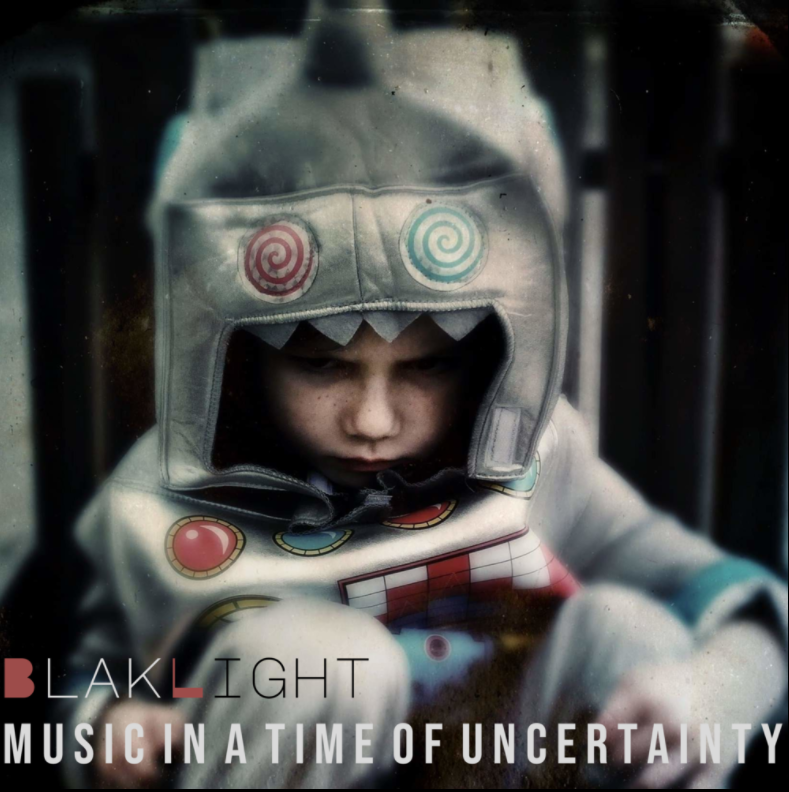
Since discovering “Isolation,” I’ve been genuinely looking forward to the release of BlakLight’s debut album Music in a Time of Uncertainty.

In many ways, BlakLight is everything I hoped to find when I began Darkness Calling. Their music is dark but danceable — emotionally weighty, yet fun. Like their album’s title suggests, it’s almost as if these songs are saying: “Dance, despite these bizarre End Times you find yourself waking up to each morning.”

Below, I’ll be providing a track-by-track review of the album, as well as embedded Bandcamp players so that you might follow along. I encourage you to sample at least a few of these mesmerizing songs. This album is truly an addictive, nearly flawless collection of synthpop.

Let’s dig in.


1. Under the BlakLight  

I’m a firm believer that albums always need to start with a bang. “Under the BlakLight” does just that, introducing both the band and the musical “universe” you’re about to enter. “When we’re under the BlakLight / Everyone sees who you want to be now,” sings Brian Belknap over Adam Collier’s infectious synth soundscape. The message is loud and clear: the songs you’re about to hear are going to strike a nerve and uncover some emotional truths — even if the heartfelt lyrics are carried on a wave of glittering pop glory. 


2. Control


I’ve listened to the album a few times now, and “Control” currently takes its spot as my favorite track on the album. This is incredibly surprising for a few reasons. First of all, it’s rare (sadly) for any song on an album to surpass its singles. As a massive fan of “Isolation” and “Unknown Love,” I assumed that BlakLight had more tricks up their sleeves, but I also figured that I had perhaps heard the “best” of what they had to offer. “Control” proved me wrong — and it’s only the second track!

What do I love so much about “Control”? Well, for one thing, it might be the darkest song on the album, sonically-speaking. The synth arrangement calls to mind Depeche Mode’s “Precious,” to give you some sort of idea (but you really should just tap that Play button above). Brian Belknap lets his voice slither in that sweet, lower part of his range for the majority of the song, until the final line in the chorus, when dual Brian’s harmonize: “It’s too late to take control.” What a moment.


3. Isolation 


I’ve gushed about “Isolation” before, but why not do it again? It was my introduction to “BlakLight,” and months later, it’s still an undeniably fun track to listen to — one that I can never bring myself to skip, with lyrics that romantically paint a picture of the fragile world we now find ourselves in: “Come on, take my hand / Take my hand / And let’s dance in isolation.”

The driving synths will pump you up, making for a perfect workout track — but Belknap’s crooning voice and bittersweet lyrics offer a glimmer of melancholia that makes the listener hesitate. Is this a reprieve from the bleakness of our world — or a reminder that things may never be the same again?


4. Unknown Love


The second single by BlakLight is equally irresistible. Granted, I’ve probably heard it more than most — as this track has spent some considerable time on our Spotify playlist — but I still find myself absent-mindedly singing it from time to time. “If you are there / You are my unknown...”

Listen to this track once and try not to think about it tomorrow. (You can’t do it!)

This song also contains one of the most heart-wrenching lyrics on the album: “I dream just to see you.” It’s hard to tell what’s better: the emotional vocal delivery or the words themselves.


5. The Sound

When these guys sequenced their album, they knew what they were doing. While “The Sound” is by no means a bad track (This album doesn’t contain any), it might not be as memorable as some of the other offerings on BlakLight’s debut. With that said, it’s placed comfortably in the middle of the album at Track #5. If this had been the first song I’d ever heard by these guys, it still would have impressed me, but “The Sound” is somewhat overshadowed by the preceding musical journey.


6. Bittersweet


The word “Bittersweet” is probably the perfect word to describe the feeling that Brian Belknap evokes with his lyrics. So many of these songs seem to describe a fantastic love that has deteriorated for one reason or another — remembering the highest of highs from the lowest of lows.

“Bittersweet” (the song) has some neat moments: namely an electric guitar that permeates the track (provided by Pano Coromelas). It’s a classic little 80’s touch that doesn’t overpower the song or put it into kitschy synthwave territory. This might be the most “different” sounding track on the album for that reason, but it doesn’t disappoint.


7. I Remember Nothing

Outside of “Control,” this is another one of my favorite tracks on the album. “Something in me fades and dies / I remember nothing.” If you’re just reading these words, you may wrongly chock them up to melodrama. But when Brian sings these things, you can tell he means them. Of course, it helps that it’s all balanced by Adam Collier’s perfect synth programming. If you’re not sure if you’re in the mood to dance or cry (In 2020, who can tell?), this is the perfect track for you. 


8. This Lonely Night

“This Lonely Light” was recently released as a single, but I actually held off from listening to it until I could hear the album in full. Listening to it now, I can tell why it was chosen as single #3. It features a catchy synth arpeggio throughout, a driving snare, and a soaring chorus that really highlights Brian’s knack for channeling grandiose, almost operatic visions of love: “Tearing the walls apart / We’ll leave this place behind / And if it never stops / This lonely night.” 


9. Last Chance


Who said disco was dead?

Despite its placement as the second-to-last track on the album, “Last Chance” is another contender for a strong BlakLight single — just one more indicator that this is a very strong collection of songs. “Last Chance” features one of the band’s catchier choruses: “This is our last chance / We have to move on…”


10. Lost... 

And so the journey ends — but not with a somber, dying gasp. Prepare yourself for a flurry of keyboard flourishes and buzzing synths. You’ll have so much fun dancing in your living room that you may not notice when Belknap sings, “Everything I know seems so distant / What is it for? / It could all be gone in an instant / I’m lost…” 

Thursday, November 19, 2020

INTERVIEW: BLOOD HANDSOME AND LUKE LECOUNT TEAM UP TO “GIVE” US ANOTHER SPECIAL VIDEO


“The end result was so mesmerizing to watch. This video is like sitting down for a short movie.”
— BLOOD HANDSOME

If you’re familiar with our playlist, you know Blood Handsome. His video for “Love Lost,” directed by Luke LeCount, is also one of the standout indie music videos of the past year.

Needless to say, when we heard that Luke and Blood Handsome would be teaming up again for “Give,” we knew we were in for a treat.

Of course, at Darkness Calling it’s not enough to just watch the video (as satisfying as it may be). We had to know more. Luckily, Blood Handsome was kind enough to chat with us about his gritty, new, neo-noir video. This time around, we also gained some interesting insights from director Luke LeCount.

Read on below. 


DARKNESS CALLING: What was the writing and production process like on “Give,” and were there any real-life experiences that shaped the song?

BLOOD HANDSOME: Writing this song was challenging because the instrumentation is so different when compared to my usual sound. You can definitely tell that it’s still very much a Blood Handsome song, but it’s very different and stands out amongst the rest. I wanted to make something unique with this track. I understood not everyone was going to get it, or might be taken aback because it doesn’t sound like your typical Blood Handsome song. But I also think that’s why it’s such a strong track. This song has so much feeling and emotion behind it.

The song is about optimism even after failure. Remaining strong and staying true to yourself, despite failures. We have to keep going and giving it our all, time and time again.

“The song is about optimism even after failure. Remaining strong and staying true to yourself, despite failures. We have to keep going and giving it our all, time and time again.”
— BLOOD HANDSOME

DARKNESS CALLING: Did your interpretation of the song influence the video, or did Luke take it and run with it?

BLOOD HANDSOME: Luke and I wanted to do something different for this video — make it its own thing outside of just what the song is about. Something cinematic. Luke and I had been bouncing around the idea of a video for this song for close to a year now. I’m a fan of letting a music video serve a second purpose and breathe new life into a song, so that’s what we did — tried to make the video its own thing completely. Luke and his team are such a creative force when it comes to making the visuals match the feel of a song. The end result was so mesmerizing to watch. This video is like sitting down for a short movie.


DARKNESS CALLING: Luke, what did you learn while making the “Love Lost” video that helped you make “Give,” or was it a different beast entirely?

LUKE LECOUNT: The creative energy that went into the making of the “Love Lost” video absolutely carried into the making of “Give.” I definitely thought of them as companion pieces, with some huge contrasts between the two — the stronger narrative aspect of “Give” being the major difference.

I shot “Love Lost” with a Panasonic Palmcorder that a friend of mine picked up for me at a flea market for $10. It was made in 2002 and shoots on VHS-C’s, which are just like little mini-VHS tapes. Looking at these pixelated, distorted images created by this old piece of junk totally mirrored the weirdo world that was the summer of 2020 in Coronavirus infested New York City. What I learned most from “Love Lost” that I brought into the making of “Give” was how I wanted to digitally capture and build upon the current environment of the greatest city on Earth.

“Give” had been more than a year in the making. Gerren (Blood Handsome) called me from Los Angeles in October of 2019 and told me about this video idea he had. We are always so creatively in-sync and I wanted to do it immediately, but unfortunately I had only recently moved to New York and hadn’t yet been here long enough to develop the relationships I needed to pull off something this ambitious. It continued to hang around in my brain though, and I was lucky enough to meet the people I needed to bring this into existence.

The thing that made “Give” so much different from “Love Lost” was the amount of collaboration (and luck) that needed to happen to bring it into fruition. Eight people worked on this music video, and that may not sound like much, but those eight people worked on something that was made with NO BUDGET.

“Give” is rougher around the edges than I wish it was, but I am so proud and grateful to everyone who gave me their time and energy.


DARKNESS CALLING: Do you and Blood Handsome go way back as friends, or did it begin as a professional relationship?

LUKE LECOUNT: Gerren and I met at one of his shows in 2016. He went on tour with a best friend of mine (Grey Gordon), who introduced us. I saw him perform and he fuckin’ blew me away. We became buddies after that, and I’ve been a huge fan of his, as well, ever since. I flew out to Los Angeles in February of 2019 to spend a week with him so we could make a music video for his song “Lasher.” That experience brought us a lot closer, and I now consider him one of my best friends.

He’s also one of my favorite musicians on the planet, and I feel so thankful that I get to work with him and add my own takes to the Blood Handsome Universe.

“I have almost grown to despise the way a pristine digital camera image looks. It doesn’t look or feel like real life to me in the way that actual film or shitty (older) digital formats do.”
— LUKE LECOUNT

DARKNESS CALLING: Can you tell us more about the film influences that shape your work and “Give” in particular?

LUKE LECOUNT: It’s cheesy and “uncool,” but truthfully, Martin Scorsese is the beginning and end of everything I love about film. Everything I make is probably because of him on some level, but I am definitely attracted to the more “ugly” side of things, visually.

“Give” was shot on a Panasonic MiniDV camera that was made in 2004. Like the VHS-C tapes that I used for shooting “Love Lost,” MiniDV’s have definitely lost their use to other “better” digital cameras. For better or for worse, I have almost grown to despise the way a pristine digital camera image looks. It doesn’t look or feel like real life to me in the way that actual film or shitty (older) digital formats do. Director Michael Mann’s digital work in the mid-2000’s on movies like Collateral or Miami Vice is brilliant to me. He doesn’t try to make the image simulate celluloid. He leans into the fact he’s shooting on digital and it’s its own beautiful thing. I wanted to show the fuzzy limitations of the MiniDV on “Give.”

I first became familiar with this format after watching Harmony Korine’s Julien Donkey-Boy years and years ago. Like every punk that’s into film, he’s a big influence for me — not only for his aesthetic choices, but his thematic ones, as well.

“Give” is very much a reflection of the types of crime films that I love, and more specifically, the grimy New York crime movies that I love. I’m a huge fan of cinematographer Sean Price Williams (Heaven Knows What, Jobe’z World) and I’ve luckily gotten to be friendly with him here in the city. He’s always generous with his advice and is a legend to me.

Additionally, “Give” was also somewhat of an exercise for a short film that I currently have in pre-production (that Blood Handsome is doing the music for). I learned so much from this experience, and it’s only going to make that project better. 

Friday, November 13, 2020

INTERVIEW: REBUILDING THE MACHINE — MIND MACHINE RETOOLS FAN FAVES FOR ‘SAYING SORRY EP’


“We were very young the first time around, so this has been like a completely new experience.”
— BRIAN BELKNAP

If you’ve listened to the Darkness Calling playlist, chances are you’ve heard the voice of Brian Belknap. He’s one half of BlakLight, one of our favorite dark discoveries. Of course, BlakLight isn’t Brian’s first project. In fact, he’s probably better-known on the synth scene for his work with Mind Machine, a darkwave duo that can be traced back to the early nineties. If you’re not familiar with their music, you’re in luck on this Friday the 13th, as today marks the release of their Saying Sorry EP, a brand-new collection of six dark-but-danceable tracks.

To learn more about their new release — and the origins of this prolific cult favorite — we spoke to Brian B. and the other Brian in the band, Brian Olsen, who provides the bleeps and bloops that make Mind Machine blow our minds.

Read on below.


DARKNESS CALLING: Thanks for chatting with us! What can you share about the writing and production process for your new song “Saying Sorry”? We love how it captures the melancholy-yet-fun sound of 80’s greats like Depeche Mode (while still sounding undeniably modern).

BRIAN O: You’re welcome, our pleasure. And thanks for the compliment. It’s funny because that particular track is one of the first songs I wrote for Mind Machine back in 1990. But other than performing it once in concert, we never did anything with it. But earlier this year, that song randomly got stuck in my head. I always liked the hooks and chord changes in the song, but never was happy with the arrangement and found it quite repetitive. I decided for fun to completely rearrange the song and give an updated take on the production. The old version had four verse parts and four chorus parts, so I cut those in half and tried to make the song sound more full and interesting by adding a few more arpeggiated sequences and melodic parts. I kept the original lyrics intact, which had a contribution by our former bandmate David Blatty (He wrote the third and fourth verses). The new version was originally gonna be used for our live set in 2020 (as were the rest of the tracks on the new EP) but obviously it had to sit on the shelf. So we thought we’d just release those songs this year since we had nothing else in the works for 2020.


DARKNESS CALLING: You also resurrected some other older tracks for this release — namely “Swimming Pool” and “Face the Nation” — which were released on your first demo album back in 1991. What was it like dusting off these songs? Do you cringe when you hear the old recordings, or does it make you feel nostalgic? Maybe a little of both?

BRIAN O: Yeah I cringe a bit. [Laughs] But then I remember that we were kids back then. And even though I think I wrote okay songs back then, I was just learning how to program synths and layer melodies. The lyrics, too, were not my best works, but again, considering I was sixteen or seventeen when I wrote a lot of them...

“Face the Nation” is a true classic in our Mind Machine history. I think we played it live at every show we did in the early 90’s, and it was a fan favorite. I had to redo that one for the live shows that never happened. Brian B. persuaded me to rework “Swimming Pool.” It’s one of his favorites from that demo album.

BRIAN B: “Swimming Pool” has always been one of my favorites from our past, and it’s my favorite from this EP. I’m so glad that we got a chance to improve on the original. There’s definitely some cringe and nostalgia with those recordings, and the remnants of a youthful enthusiasm. But we’re not embarrassed of where we started. If we were, we would have never put them online in the first place. I quite enjoy rough recordings of my favorite artists, and hearing how they’ve evolved over the years.


DARKNESS CALLING: This new EP is one of many great releases you’ve had since reforming in 2015. What is it like working together again after a 20 year hiatus? (1995-2015) How did the reunion happen?

BRIAN B: We were very young the first time around, so this has been like a completely new experience. Much of our time back in the day was spent hanging out, and we really should have got a lot more accomplished than we did. These days, though we rarely see each other in person, we chat online nearly every day and work solely by sending files back and forth. After finding a box of old cassettes back in the summer of 2014, we started reminiscing about the band. We initially posted some of our old recordings on Soundcloud in early 2015, just for fun. It slowly evolved into discussing how we could record new material. Since neither of us had any recording equipment, we began by adding vocals to some of our unfinished 90’s demos, resulting in our Movement release in 2017. Eventually, we felt that there was unfinished business, as we began working on new material for what would become the 2019 album Return to the Machine.

DARKNESS CALLING: COVID threw a wrench into everyone’s touring plans. Some artists have ventured into livestream broadcasts as a way to fill that void. Is there any potential for a Mind Machine livestream in the future?

BRIAN B: We haven’t played live since 1991. The Saying Sorry EP was conceived because we had finally confirmed a show for January of this year, so Brian O had re-programmed some of our early material for live shows. Sadly, the show fell apart (for non-pandemic related reasons), and though we had hoped to put some more shows together, Covid-19 hit and those plans were axed. We’d like our live return to be on the stage, so it’s doubtful that we’ll do a livestream any time soon, though anything is possible.


DARKNESS CALLING: Your new EP also has an updated version of “Evil Girl.” This is one of the EP’s standout tracks in our opinion, and it’s pretty different from the original track. Can you tell us more about the genesis of this song and how the new version came about?

BRIAN O: Well, I composed this one back in 1992, and originally it was an instrumental called “Stupid Girl” (This is the reason the version on the EP is called “Stupid Version” — It’s my little inside joke). I changed the title before writing lyrics a few years ago for a couple reasons: Garbage had a hit song with the same name, and my wife didn’t care for the title!

[Editor’s note: I also thought of the Garbage song, and my wife has never been able to get past that song title, either! A little defensive?]

The intro riff in the new version was actually a melody idea I had that went nowhere. When I put a bassline down for it, I realized it was the same chords as “Evil Girl,” so eventually I just made it into a new version. Yeah, I’m really thrilled with how this one came out. It’s almost more like a club or dance version, but very clean with a lot of sharp, stabby sounds. Brian B’s vocals really shine here as well, as I think they did for the entire EP.


DARKNESS CALLING: Thanks again for chatting with us! Is there anything else you’d like to share with our readers? Any other new releases/upcoming collaborations that should be on their radar?

BRIAN B: Thanks so much for having us! We’ve got a song on an upcoming release, Living in Oblivion: A Tribute to Anything Box, which we don’t have a release date for yet, but we hear it’s coming soon. We’ve covered one of our favorite tracks, “Do You Hear Me Anymore.” Anything Box was a huge influence on us when we were starting out, and we’re honored to be a part of it. Additionally, all proceeds will benefit Claude from Anything Box, who is dealing with some huge medical expenses. Brian O will be getting to work on new Mind Machine material in 2021. In the meantime, my project with Adam Collier, BlakLight, is releasing our debut album Music in a Time of Uncertainty on November 20th, and Brian O has a side project that he’s between toiling away with, as well.

DarknessCalling.net Is Now Darkness Calling

Hey, folks!   Here, you will find an assortment of archived blog posts from the ashes of DarknessCalling.net While we had a great time runni...